Showing posts with label pollution. Show all posts

April 19, 2012

Thunder over the Ohio River

Saturday is Thunder over Louisville, the kick-off to Kentucky Derby season.  The thunder is two-fold:  the thunder of World War II warbirds and spanking new F-18s in the afternoon and the thunder accompanying what is said to be the country's largest fireworks display Saturday night.  (The same was said about the fireworks over the Hudson River on July 4, 2002, which I watched from the roof of an 8-story building on the campus of New York University.  Which was more impressive?  Well, the NYC folks had two barges from which they were firing; and that night was the only time I've felt a crowd step backwards en masse because the pyrotechnics seemed about to engulf us.
 The question is neither here nor there today, because I'm thinking instead about the best place to go to take photos of the planes in the afternoon.  I was hoping Riverview Park would work, but it seems to be in the lowlands.  I want to be closer to the sky, and God, and mostly the planes on Saturday.  The downtown waterfront is always an option; but I'd rather be away from the crowds.
 I love seeing the barges pass.  Growing up on an island, the freighters were always at a far distance, so I'm surprised each time I see a vessel this large up close.
 Relics nearby.

September 21, 2011

Industrial photography

 The trip home from North Carolina was long and involved the return of the rental car and pick up of my repaired jeep, so I spent a night at a motel somewhere in West Virginia on the way home.  Walking Laramie the next morning, I noticed this electrical power station.  You couldn't actually miss it; if I'd tripped while walking the dog, I'd have rolled down a cliff directly into the fence surrounding this location.
 I went back into the motel room to retrieve the camera so I could take this photograph.  I adore the lines and curves and intricacy of this construction.
 And here's another view, the towers tall against the sky (I may have been lying on my stomach to take this photo).

April 23, 2011

The Good Stuff Rescue League. Fibonacci 91.

 The Good Stuff Rescue League

1     I /
1     hereby /
2     elect myself /
3     president of The /
5     Good Stuff Rescue League.  Our /
 8    motto:  Save the landfills.
           Dumpsters worldwide cry out /
13   for your support:  "Enough with the lamps, patio furniture, cedar chests, car batteries, /
21  text books, fake Christmas trees, heirlooms from your grandmother, wastepaper baskets, lawn mowers, digital whatevers, wicker baskets, wall hangings, et cetera."

1    Take /
1    your /
2    good stuff /
3    anywhere but Goodwill /
5   Industries, where, up the street, /
8    good stuff meets trash compactor after several weeks /
13  on the shelf.(I could do that myself and save on gas money.)

1    We're
1    having
2    our first
3    membership drive today.
5   Sign up, and you'll get
8   a certificate on copy paper suitable for framing.
13   Oh, picture frames! Dumpsters don't want those, either, nor dog beds nor bicycles.
                                           by Mary Cartledgehayes

February 4, 2011

Fibonacci Poetry365 . 35 Tax Refunds

Tax Refunds

1    It's
1    throw-away-your-couch
2    week at
3    the dumpster. Three,
5    so far.  Lamps are optional.
                          by Mary Cartledgehayes

January 30, 2011

Fibonacci Poetry365. 29 -- Boycott Whole Foods

                               Boycott Whole Foods
1   Sick
1   to
2   death of
3   winter, I entered
5   Whole Foods. Just inside the
8   door stood pot after pot of huge purple
13   hyacinths, the kind that bloomed at my mother’s house. I thought about the
21   sweet, sweet aroma; approached and breathed deeply, nose to florets, one flower, two, six, each a heady warmth of memory.
34 When I got home and turned on the news, I learned that Whole Foods has advised the US Department of Agriculture that they agree to “conditional deregulation” of genetically engineered seeds, beginning with alfalfa.
55  Monsanto is the bully on the block, demanding change, suing small farmers, shoving its new and better grains down our throats.  Did you know not a single law requires them to tell us what’s been engineered?  They’re afraid we won’t eat it if they do.
                      In reading on this topic, I learned that in 1969
89  Monsanto dumped 45 tons of PCBs into a creek that supplies drinking water to Anniston, Alabama.  For forty-some years, they’d dumped PCBs and also mercury, renowned for its toxicity, into that creek.
        In 1968, I was pregnant in Anniston, Alabama. In 1969, I breast-fed my infant in Anniston, Alabama. All that time, and more, Monsanto was spiking the water I drank. In 2010, I had cancer, and what about my baby?
        Human beings, not the bottom line, are the bottom line. Time to act as though we believe it.
.

October 11, 2010

Varmint Watch


 This is a not-to-scale drawing of the trees in our neighborhood all summer long.  The orange lumps are bad-tempered squirrels.  Those little scumbags would cheep and click at the dogs every time they saw one. Yes, I know it's a mystic spiritual animal communication system; but I also know there aren't enough predators in my neighborhood for the number of varmints.
 
Therefore, this weekend there was a huge squirrel roundup, with professional critter wranglers stalking the grounds and roofs, installing cages and gathering up hundreds of squirrels, as well as assorted possums and chipmunks, all of which had taken to traveling in packs and shouting insults at the community dogs. We believe they all now live on a beautiful farm out in the country.  I'm cheering for the feral cats' side.

I can't believe I went to all the trouble of creating an authentic and also realistic drawing (except for the squirrels being orange).  One day you're blogging and the next day you're putting yourself out for other people who aren't visual enough to catch images on their own.

September 9, 2010

Upcycled Art: Temple to a Dying Planet


This is the Upcycled Art piece I entered in the Kentucky State Fair.  In earlier posts you can see that it began as wire holders bolted together to hold up a slab of wood I pulled out of a dumpster.  Here you can see the fringe surrounding the table (made from Dunkin Donuts coffee bags inside out and edged with left over bits of fringe from various projects over the last five years).


A pull-toy dog with his nose chewed off, a Grace keychain, part of a map of the world, and one side of the Great Pacific Garbage Dump.

The other side of the Great Pacific Garbage Dump.  The fishing line is a glob of it I picked up while walking the dogs at the Ohio River a few months ago.


The Temple Guardians were given to me by a friend nine years ago and have done good service heretonow.  They are attached to the table using old tubing from my C-PAP machine.

Bits and pieces are glued all over, including a turquoise Barbie shoe at one of the guardian's right ear.

The best view I could get.  The group of primary-colored crates behind were a machine or monster (or, if you're living in the eighteenth century, both machine and monster).  The piece is about 5 feet tall, 6 feet long, and 2 feet deep.

August 23, 2010

What I won at the Kentucky State Fair

The distant view of my photo with the green Honorable Mention tag.  It's second up from the bottom on the left and shows up not at all in a pile of other photos.

Now you can see more clearly that it's a brand new grocery cart lying on its side in a creek -- Beargrass Creek in Louisville, where I've been taking photos for several years now, many of which feature trash.  No photo-sopping was involved with this photo, so it must have been the time of day making the creek appear so blue, because I've never seen it that color.

I've been saying that I've never won a ribbon before, but I don't know if that's accurate.  I've had two pieces of art, both collages, both textile, win prizes in competitions.  The first was in an art show at the Duke University Divinity School, where I think I won third prize; and the other was in the annual Spartanburg Sidewalk Art Sale, where art is hung on the gates surrounding Converse College.  That time I won second place and also a check -- I think it was 2001.  But did I get ribbons, and if so where are they now?

I suppose I'll have to clean out the file cabinets to learn the answer.

March 21, 2010

Sunset on the Ohio


Down by the (Ohio) Riverside

The edge of the Ohio River.  Every time I visit, I see at least one flip-flop traveling on its own.


This wood was beautiful enough that if I could have lifted it, I'd have brought it home.  If I'd had some rope, I could probably have created a sleigh of sorts, rolled this piece onto it, tied it to Koko's collar, and had him pull it for me.  He'd have laid down for a few naps along the way, but surely he'd have enjoyed it?

I suspect most of the junk beside the river got there inadvertently -- things blow off boats in the wind, and dolls fall overboard, and rain washes things off.  See, that's the trouble.  It's not the litterers who are the problem (unless we count the don't-pick-up-their-dog's-crap litterers; I blame them profusely).  Even fine upstanding folks put paper cups and broken dolls into garbage cans, and all it takes is one stiff wind or a typical Louisville minor flood -- which would be major most other places -- and all of these things become one with the environment.

The Ohio River at the end of winter


The south bank of the Ohio River walking west from the boat ramp.  The drain on the left is half filled with leaves and branches.


I love the upright shape in the photo on the right, above.


Now how do you suppose this found its way here?  Fell  off a truck? Pushed off a boat?  Dragged/dumped there by a renovator who didn't want to pay the expense of getting rid of it?

February 4, 2010

Animal husbandry

I'm just in from a 45-minute walk with Kokomo.  He's taken to snatching up hunks of poop that he finds on the ground, thanks to the idiot and irresponsible dog owners around here who think their own personal dog's poop doesn't stink or pollute or get on other people's shoes.

My position is that Koko's eating poop because he's bored and not getting enough exercise, so I've been taking him further afield lately.  Today we are at the very end of our grand tour, maybe 25 steps from home, when his head dropped, his mouth opened, and he scooped and swallowed in one gulp.  Maybe my compadre is correct; maybe it's a vitamin deficiency.  And maybe one of these first days one of us will actually call the vet or look online to find out what the likely cause really is.

My reward for the big walk was discovering in the mailbox five (5) fabulous postcards and a letter from my pal Jack.  I love the postcard above. To my British grandfather who worked in a granite quarry and built houses and raised sheep: this one's for you.

August 6, 2009

Louisville Flood

Draut Park / Beargrass Creek on Tuesday afternoon


March 16, 2009

A mud puppy and an eastern hellbender went into a bar . . .


one big salamander
Originally uploaded by ratterrell


I went looking for a mud puppy this morning and found this photo on ratterrell's flickr site. He'd been ice fishing in Wisconsin, caught what he thought was a walleye, reached for it, and stopped when he spied the fella in the photo.

He says it kind of freaked him out,coming up from the dark water. I understand. When I was growing up, my parents owned an ice-fishing business on Lake Erie, and mudpuppies like this were sometimes on the end of our lines, too. Salamanders, they are.

Ice fishing came to mind when I opened the Spring 2009 Kentucky Afield and found "On the Prowl for Devil Dogs: the search for the disappearing eastern hellbender" by Danna Baxley. The hellbender was once prevalent in Kentucky. In an exhaustive search last year, our Department of Fish and Wildlife Resources turned up only 11.

What's causing the demise of this remarkable salamander? The usual things: "siltation, water pollution, all-terrain vehicles (ATVs) in waterways, dams, overcollecting, disease, and killing by the public" (p. 28).

If you happen upon a salamander one day and want to know if it's a mud puppy or an eastern hellbender, count the toes on its hind feet. Mudpuppies have four per foot; hellbenders have five. Also, while mudpuppies have gills, salamanders don't. Finally, take out your tape measure. The largest mudpuppies are 13" long. The hellbender can grow to 29 inches and a rollicking 5 punds.

The hellbender's other nickname -- snot otter -- offers another clue to its mystique. Pretty? Depends on your outlook. Unique? Yes. Worth preserving? Yes.

December 30, 2008

Bruggers in USA Today

James Bruggers has published a brilliant article in U. S. A. Today regarding Louisville's remarkable progress in improving the city's air.

Last year, the air in Lexington, Kentucky, was ranked worst in the country. Louisville's air was third-worst. But we are coming up fast due to monumental commitments on the part of government and industry.

December 20, 2008

Plastic bags gone wrong

Click on the photo to see how the squirrels near Beargrass Creek used plastic bags in constructing their nests. One of the reasons plastic bags cause such damage is that they're light and fly on the wind into the trees, where animals who never need to carry things home from the grocery store then use them in new ways.
Click the photo for a close-up so you can see more clearly.

Beaver in one of the Harbourfront Gardens


Beaver in one of the Harbourfront Gardens
Originally uploaded by elPadawan

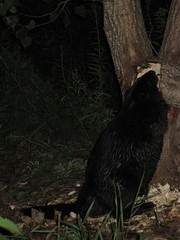
Here's a photo that gives you an idea of the beaver's size. As I said, they're big animals, thick verging on square. Nothing cute about these guys.

Thanks to elPadawan from Canada on flickr.com for allowing this photo to be blogged.
Beaver


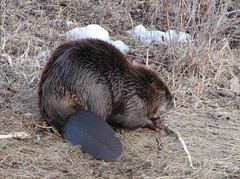
Beaver 1
Originally uploaded by annkelliott

And here's a photo of a beaver in Canada. It looks just like the ones we have in America. (Actually, I've only seen beavers from a great distance, and they're larger than you might suppose. They're at least twice as big as possums and solid, the way a cow is solid.

The photographer says in the accompanying text that the beaver population in Canada was nearly wiped out in the 1930s (I'm guessing they were being trapped for their fur) but they've been restored because of conservation efforts. She happened upon this one while walking in a local park.

October 18, 2008

Nature Round-up Louisville

--The ozone level in Louisville has topped federal standards 8 times this year. The most recent day was August 19, with a preliminary reading of 82 parts per billion. The standard is 76 parts per billion. (Courier-Journal, 8/21/08 B3 col. 1) Louisville, by the way, has the fourth-worst air quality in the country and is struggling to make improvements. Louisville's wonderful, but no matter how high the quality of life, you can't enjoy it if the toxic air kills you. You can find more information about air quality on the city's website.

---According to an Aug. 29 story by Bill Wolfe in the Courier-Journal, Louisville is likely to miss the 2012 deadline for reducing its greenhouse gas emissions to 7 percent below 1999 levels. In 1990, we produced 18.2 million tons of greenhouse gases. In 2006? 19.7 million tons. Projection for 2012: 20.2 million tons. It's hard to reduce pollution when the city is growing. Coal-fired electricity generation accounts for 80 percent of residential emissions; 89 percent of commercial emissions; and 97 percent of industrial emissions. According to LG&E, we're 95 percent coal-fired. So where's that clean coal the Republican nominee for vice-president was chattering on about at the convention? It's an easy phrase to toss out, but achieving it is something else again.

August 26, 2008

Nature Roundup -- Kentucky and Beyond

8/22/08 Courier-Journal, D1, col 1. The Food and Drug Administration is now allowing radiation of spinach and lettuce. Meat, particularly ground beef, has been irradiated for years.
So much for the health benefits of spinach and lettuce. I'm supposed to believe the FDA when it says radiated food is safe? Won't it take a generation or two of people eating it for us to know?

8/22/08 Courier-Journal/Stephenie Steitzer, B1 col 3. Kentucky, which somehow became the storehouse for 532 tons of nerve and blister gases, is on track to destroy all those materials by 2017.

8/22/08 Courier-Journal/AP, A6, col 1. The AP reports that a part of the Arctic thought immune to global warming has a 7-mile long crack. There are stunning photos and videos showing the flow of glaciers into the sea at the Extreme Ice Survey website.

Dan Mongiardo, Kentucky's lieutenant governor, is planning a survey of nature preserves and wildlife management areas with an eye to allowing ATVs into areas where they've been prohibited. Mongiardo and Jane Beshear, the wife of the governor, think rural economies will be helped if more trails are available for "hikers, bicyclists, horseback riders and ATV users." Don Dott, director of the nature preserves commission, thinks ATVs are not compatible with biological diversity. (James Bruggers, Courier-Journal, 8/21/08, B4, col. 1) I'm told that horses are far more destructive on trails than ATVs.