Showing posts with label global community. Show all posts

June 27, 2012

The Art of the Tidza Parade

http://www.youtube.com/watch?v=i5apP6-7LAs&feature=colike

My cousin just provided the link so I could see the 2010 parade in Tideswell, the small town in Derbyshire, England, where my father was born.  He left to join the navy when he was 17 and returned only for the rare visit.  My mother kept up the communication with his family, and so I knew about Wakes Week and the annual dressing of the well, a holiday celebrated on June 24 each year, which is St. John the Baptist Day and my friend Mary Flowers' birthday.

I just learned here that the custom of well-dressing is peculiar to Derbyshire.  Here's a bit of information:  
"This ancient custom is only found in Derbyshire and is the art of decorating springs and wells with pictures made from natural materials. Four wells are dressed in the centre of Tideswell.  Wells have been dressed at Tideswell since 1946. Refreshments are available around the village.
"Well locations: Fountain Square – main Well; Church Yard – Three wells dressed by Scouts, Guides and Tideswell School."

One participant posits that the custom of well dressing is a "Christianised vestige of early ritual celebrating the healing miracle of clean water" -- and it's not hard to imagine the custom having developed while the area was still pagan.  Bless the water, which, as we in America are becoming more and more aware, is life.

I met Betty Friedan at Forum '85, a session held in  Nairobi, Kenya, concurrent with the United Nations End of the Decade for Women Conference in 1985.  I happened upon a tree with a note attached informing anyone who cared that Betty Friedan would be there every day at a given time for an hour or so, and everybody was welcome to join the conversation.  One of the days I attended, some Kenyan officials (male, in suits) came to ask Betty what women wanted.  She deferred to their countrywoman, whose name was Sarah.  Sarah stood and replied that what women want is schools, firewood, and water.

Clean water.  Potable water.  Water close by.  Water not contaminated by coal ash or pesticides.

Women still want clean water, which takes us back to the well dressings in Derbyshire. Here are a few photos:
The 2011 Tideswell well dressing

England faces the same crisis with small post offices that we are in the U. S.


The point of all of this is to say that I've always wanted to go to a Tideswell well dressing.  When I told my cousin Danny, he posted the youtube link for my viewing pleasure.  I am filled with questions after seeing it, mostly things like what the money being collected was to be used for and how exactly did one find one's way into such a parade.  Then I dwindled off into thinking that by rights we ought to take part in that parade ourownselves, if we could settle on a theme.  (Actually, a pseudo-theme looks to be sufficient.)  Which leaves only one more thing to be resolved:  whom do we know in Derbyshire who owns a tractor and what would it take for them to let us use it on parade day?

March 22, 2012

Ice Fishing -- on a Finnish blog

If one of our intentions is to see more of the world and let the world see more of our day-to-day life, then you must join me in visiting my newest colleague.   Teuvd Venkalahti lives in Finland, collects cameras, and has some fabulous photos on his blog of "lada niva ice fishing sleds on roof" of his car, flies preparing to give their lives for fishermen, and one ENORMOUS fish.

Pop over for a look, while I pop over and see if he'll let me post one of his photos here.

January 30, 2012

Art Project 52-4. The Sketchbook Project

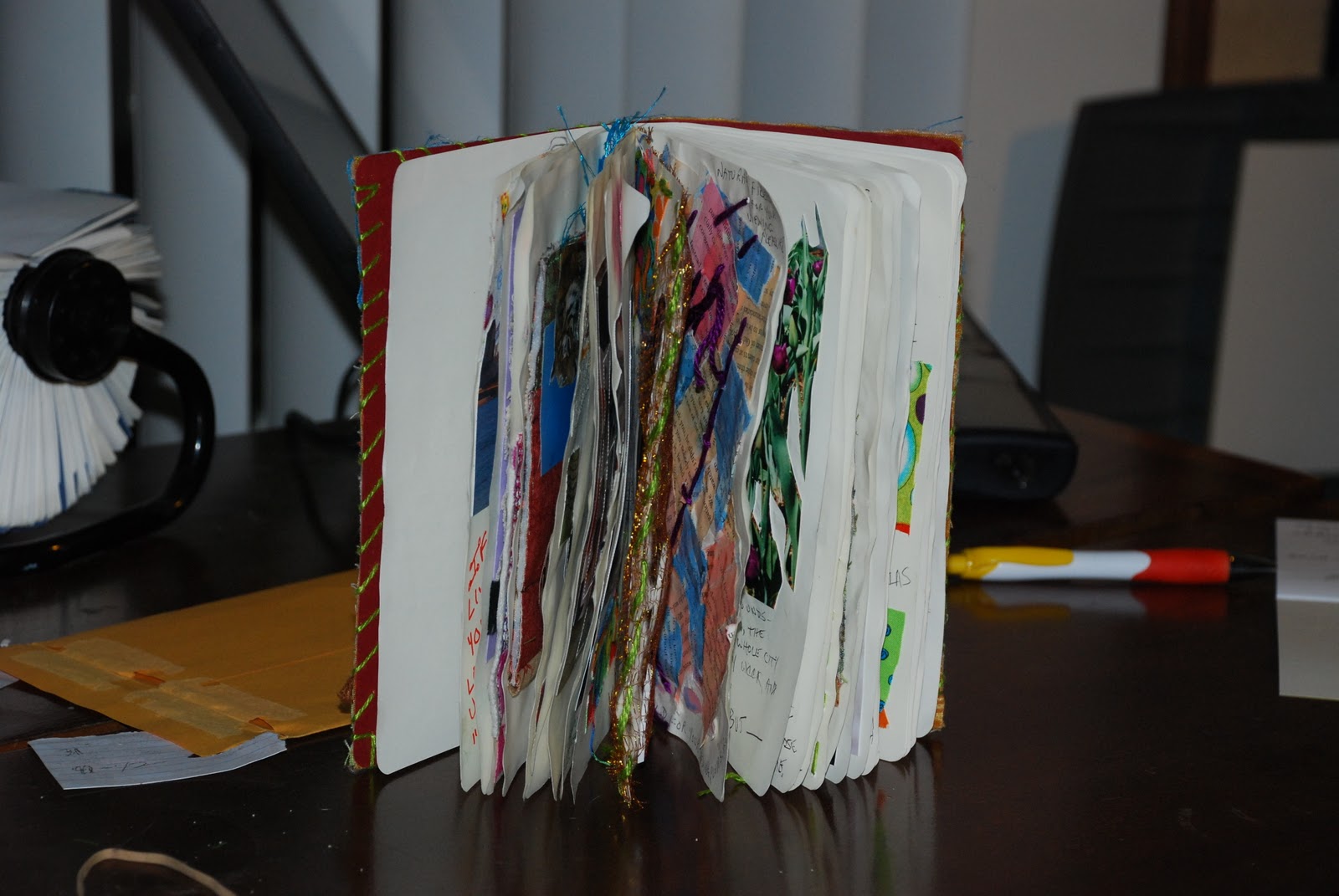
 January 31 is the postmark date for The Sketchbook Project. I'm ahead of the game; my sketchbook is ready to go in the mail today.

I started late and was controlled by the instruction to stay dry:  "Your book should be finished at least 48 hours before mailing" to allow all of the paints and glues to dry.  I needed a quick-dry medium to begin with that would allow me to do a backgrounds without having to wait for each page to dry. Thus the decision to use colored felt-tip pens.

The pens weren't enough in themselves, which is why I added bits of photographs.  Somewhere in that process, I realized I needed to add text in order to make sense for other people of what was obvious to me.  That's the reason for the black lettering, which, in the best tradition of any kind of art, reached a conclusion that surprised  even me.

 WHO GAVE YOU PERMISSION TO SCRIBBLE LIKE THIS?
 WAS IT THE SUN, HURLING ITS GOLD UPON YOU?
 WAS IT THE ENDLESS NUMBER OF SHADES OF GREEN?
 WAS IT THE EAGLE,
 OR WAS IT THE EARTHWORM?
 WAS IT YOUR HEART, POUNDING, ROLLING LIKE A WHEEL ACROSS CONTINENTS AND TIME?
 WAS IT THE SHADOWS -------   OR THE RULES?
 PERHAPS PERMISSION CAME FROM THE STEADFAST AFFECTION OF OTHERS OR
 FROM YOUR OWN LOVE OF LANGUAGE AND OF
 COLOR.
 THE GREATER GOOD
 DEPENDS UPON -------- FREEDOM OF EXPRESSION.
 MY BRITISH GRANDMOTHER SIGNED LETTERS XXXOOO.
 X. O.: STRUCTURES THAT BRIDGE THE DISTANCE BETWEEN US.
 DID YOU ASK PERMISSION TO BUILD, TO SCRIBBLE, TO BE FREE,
 OR DID YOU CLAIM PERMISSION AS YOUR BIRTHRIGHT?

My sketchbook is one of 4,264 created by artists around the world.

October 19, 2011

why -o -why -o whyo--

Yes, I'm in Ohio.  Have been here for days, in fact, with nary a scanner nor a cord to download my photos onto my laptop in sight.  Everybody says you gotta have photos if you're gonna blog, but I've got something better than that today.  I'm on the island where I grew up; it's cold and raining; I've been outside three times and had to change shoes and socks each time I came back in; and I'm beside myself with amazement at the workings of my mother's mind.

She has always been a collector, as well as a trader, as well as a ceramicist who became a nationally known doll artist when she began sculpting all of the First Ladies, followed by sculpting all of the presidents.  Belle's Dolls is the name of her business, and she'd still be working at it, at age 89, if her vision would allow it.

Now here's the thing.  It's gloomy and empty at Mother's house; and it's warm and bright at my brother's cottage, so I'm taking trips to the house and hauling stuff to Charlie's to (at this point -- sorting papers will have to come later) scrub.  I just picked up a small box, and this is what it contained:

Your Golden Opportunity
to start your tableware service 
FREE

The
American Bank
Port Clinton
Ohio

The pale yellow brochure shows a distinguished gentleman standing behind the dining room chair in which is seated a chic blonde woman with a slight smile and a hairstyle that looked better on her than me back in the day.  In the forefront are three beautiful tableware designs.  You can choose between Camelot (elegant silverplate), Golden Scroll (luxurious goldenware, a metal with which I am not precisely what you'd call familiar), or Nassau (gleaming stainless).  If you put $25 into a new or existing account, you got a place setting free.  But only one place setting.  If you wanted more, you had to pay for it. Each 4-piece place setting after the first was $2.99, except for the gleaming stainless, which came in a 5-piece place setting.

As is that weren't fascinating enough, tucked inside the brochure is the negative to a lovely photo of my parents.  They are in the ceramics studio.  He's wearing his huge high puppeteer's hat for presentation of a Punch and Judy show; and Mother is leaning into him, smiling.

I don't know where you people keep your negatives, but my parents' filing system outdoes any you've ever run across before. In the same pile as the Golden Opportunity brochure is a small black plastic wallet that contains a photo of a beautiful woman I think was my mother in her late teens, a card showing Mother to be a member in good standing on the Madame Alexander Doll Club,  a mermbership card confirming her place in The Genealogical Society of Southwestern Pennsylvania (expires Dec. 31, 1996); a card showing she's a member of the Fostoria Glass Society of America (expires Sept. 1990); another Genealogical membership card, this one expiring in 1995; a piece of card stock with the address of an institution on the front and, on the back, a phone number for someone clearly not in that institution.  Finally, there's a very fine, large card from Royal Doulton declaring this piece a Dunkirk Tankard, featuring a painting by leading marine artist Geoff Hunt to mark the 50th anniversary of the evacuation of Dunkirk.  Mother has tankard 632 of a limited edition of 14,000.  The tankard itself is not to hand, but I'll go look at the Royal Doulton pieces I scrubbed clean last night and see if perhaps one of the them belongs to the Official Placard.

Next to those amazing treasures is a Winston Churchill jug by Royal Doulton.  He's sitting down, black suit, brown overcoat, white shirt, blue bow tie with white polka dots, black hat, and a cigar clenched between his teeth.  I was about to plunge him into the sink when I remembered that anything Mother owns has something inside it.  I can't explain it; I'm merely reporting.  I wiggled the jug upside down, and an envelope of stamps fell out.  The accompanying paper is titled UMM Al QIWAIN 1966 and goes on to reveal that Mother has a complete set of ten values honoring Sir Winston Churchill.  The stamps have been glued together by island humidity into a group of two, two groups of three, and two singles.  Also in the jug is Something Else.  Worst of all, it's a Something Else that wants to stay where it is.  I tried using my long fingers to pull it out. No luck.  Then I tried the needlenose pliers I brought from Mother's yesterday.  No good.  I have a pair of scissors on the table but suspect they will contribute  not so much a solution as more work for me to do. 

Oh, wait.  They're pinking shears.  Those things never cut anything after the first ten or twenty years of use, so I've just used them to wriggle out the enclosure: a postcard showing Spectre Column at Luray Caverns, Virginia.  Dated November, 1980,  our new friend Jean writes that the box arrived in record time, and that her offer is $40.00, which leaves Mother a $10.00 balance on her W. C.  We can let her know if it's not satisfactory.

But how are we to tell?  The only W. C. I know about is the British water closet, a. k. a. toilet, and I can't see how Mother has a $10.00 balance there.  I'm also a little slow in understanding the relationship between Sir Winston and the postcard -- but such is life at the moment.  And now that he's empty, I shall go wash his dusty old hat and shoes and overcoat, sprucing him up into the fine porcelain figure he's been since the beginning.

Maybe a photo later?  I'd have to take it with my cell phone, text it to myself, download it, and then upload it, which is at least two steps more than seem likely.  Winston is not my only gentleman caller this afternoon.  Much remains to be done before nightfall.  But we'll see.  Check back. 

P. S.  I feel honor-bound to disclose that somewhere in a little book not currently evident, Mother wrote the date and the amount she paid for the Churchill mug. Also, I just piled the ephemera together and noticed a tiny bag of white and silver round and bugle beads.  That's less than one handful of Mother's things, and there are hundreds and hundreds of hands full.  I think I've just learned the definition of infinity - and beyond.

September 21, 2011

Reiki

The Saturday before Devin's graduation, I spent a day with Louisville Reiki master Mary Farmer learning the first elements in becoming a Reiki practitioner.

Reiki is a chakra-based modality for healing yourself, other people near and far, and, extended broadly, the world. Animals are said to benefit from Reiki, but I haven't tried it yet with Koko, who is aging and has the genetic joint problems common in Labrador retrievers.  Laramie isn't interested; she's got too much to do.

Michael fell asleep within moments of my beginning a Reiki treatment on him.  I myself fall asleep three chakras into a session when I'm doing a Reiki healing on myself.  And then there's the time I did it for Jennifer, while I was in North Carolina for the graduation.

Jennifer liked it so well that, when I finished, she dangled her right hand over my side and said, "Reiki my hand, Mama."

"Your hand isn't one of the chakras, Jenn," I said.  "I can't Reiki your hand."

"Sure, you can," she said dreamily.  "Go ahead, Mama.  Reiki my hand."

Turns out a hand can, indeed, be Reiki-ed.

This Saturday I'm taking Reiki 2, again with Mary Farmer.  I'm quite looking forward to it.  My friend Brian said, "Do you really believe in that kind of stuff?" and I said, "No, but I believe in the movement of energy, and I believe in love," and both of those things are essential to Reiki practice.They are the definition of the practice, actually.

It is also true that some time after the Reiki 1 class I noticed that I am happy where ever I am -- so happy, in fact, that I have to wrench myself away in order to leave.  In August I wrenched myself away from home to go visit my mother; and in September I wrenched myself away from home to go see my new great-niece Amy Belle and her sisters; and then I wrenched myself away from the joy of their company to return home.  It's a steady joyousness, an appreciation.  Not that I didn't have those feelings before, but now I've rearranged my life in such a way that I pass from one loving setting to another, and even the in-betweens are happy. Is it the Reiki energy realignment that Mary Farmer performed on each of us that was the source of this change? Is it Reiki practice? Is it my excellent therapist? Would I feel this way now even without the Reiki?

I don't know. I don't care. I just know that taking Reiki 2 is the right thing to do.

Be safe, be kind, be peace.

August 8, 2011

Karenzo Audace's interment, August 6, 2011

The burial of Karenzo Audace was done according to Burundian traditions, the controlling one of which is that the community (as opposed to cemetery employees) lays the deceased to rest.

When everyone in the vehicle procession had arrived at the cemetery, the wooden casket was carried under the usual green tent.  The leader said a few words, translated by an interpreter for those of us who didn't know the language (I'm not sure of the language but learned online that the three most often used in Burundi are Rundi, French, and Swahili.)  There was a song or two as well as a few words about Mr. Audace.  (Bear in mind that this service followed a two-hour service at the Pentecostal church.)  We were then told that the rules of their culture would be followed, beginning with the carrying of the coffin down a small incline to the grave.  Once the coffin was set down, it became evident that different straps were needed for lowering the coffin into the grave, causing a delay of twenty minutes or so. A few hymns/burial songs were sung.  A yellow butterfly flew past me.  A slight breeze was enough to keep us cool (the temperature remained in the low 80s).

Mr. Audace's wife, a tiny woman dressed in black, stood through the interment with her arms wrapped around and older woman whose black garments covered her entire body, including her face.  (I don't know if the term chador is correct in this instance; the family is Christian rather than Muslim.)  The two small girls were dressed alike:  dresses with black straps, a white ruched organza bodice that descended almost to the knees, and a white knife-pleated skirt that ended near their ankles.  The older daughter wore in her hair a burgundy bow the same color as the roses and ribbons on the standing wreath. The younger daughter wore a black bow in her hair.  The little boy, toddler size, wore a suit and leaned into the chest of the man holding him.

After a bit of commotion around the cemetery truck, the long straps were delivered.  The crowd surrounding the grave was six or seven deep, more in some places.  I was in the very back, our acquaintance with Mr. Audace having been quite short and my intention being only to show my respect, so I didn't see the casket slide into the grave.  But I did hear the leader say that the job of burying belonged to everyone.  There were four shovels, two quite short, two long. His widow shoveled the first dirt onto the coffin.

Way into the shoveling, I thought it would all be done before I had a chance to assist. Then I shook myself and thought, "No, it isn't true.  There's plenty of dirt for everyone."  A while later, I handed my car keys to a man standing slightly behind me on my left, stepped forward and offered my hands for a shovel.  I scooped earth and dumped it into the grave.  After the first spade-full, someone behind me offered to help.

"Thank you but no," I said.  "I need to do this myself." 

I didn't really mean myself; I meant myself and Michael, whose job responsibilities prevented him from being there to pay his condolences.

I lifted and dumped the shovel five times before someone took it from me and went to work at about ten times the speed I'd managed. Everybody paced each other;when one of the men slowed down, another stepped next to him and relieved him of the shovel.  A few songs were sung, but otherwise the ritual proceeded in virtual silence, each of us absorbed in watching the task.

It takes a long time to fill a grave, even with more than a hundred people -- maybe more than two hundred --  shoveling.  The earth had been piled on two mammoth plywood sheets when the grave was dug (I'm certain that digging was done by the community).  None was left behind on those sheets; it all ended back on the grave.  The surface was rounded, as you'd expect, and I watched two men chop at clumps of dirt with shovels while another man, wearing a golf shirt and long shorts and tennis shoes, was on his hands and knees smoothing, smoothing the dirt with the palms of his hands.

It felt like love and honor, that shoveling and chopping and smoothing.  Holy moments -- or, more accurately, holy hour or hour and a half.  And all the while, everyone stayed.

I studied the crowd from time to time.  The Burundi women wore beautiful, brightly colored batik dresses; many had ornate headwraps, which someone told me later indicated who was who (immediate family, siblings, cousins, etc.).  The men's clothing ranged from formal black suits to T-shirts and shorts.  It struck me that some people there were certainly plain-clothes county police officers or state or FBI officers  -- Mr. Audace's death was, after all, a murder -- but I lacked the skills to identify them.  The only real sign I saw was a Louisville Metro Police Department police car in a cemetery cul de sac as I drove away.

The crowd was predominantly black / African American.  A number of Caucasians attended the church service, but I only counted four, including myself, at the grave: a tall man, a blonde woman, and a third person I remember counting but whose appearance has left me.  He was probably undercover police of some variety; who else could manage to be that nondescript?

So.  All the dirt was replaced, and the grave was hand-smoothed.  A few words were said -- regret for the passing, recognition that this is not the first Burundian to be murdered without provocation in Louisville, a call for justice.  Then the flowers were placed on the grave. Precision was involved in the placement, but of course I don't know the significance of the placements.

I do know that one of the leaders held up a bouquet of flowers in his right hand and a silver pen in his left hand.  He said something like, "Karenzo was above all a teacher. The first thing he did was learn English, and then he taught it to everyone else, for no cost. This pen represents his life as a teacher. It also represents his children's right to be educated, so that they too can be teachers."  I understood that he was placing a claim on and a demand of the community, and I suspect it was a tacit but binding demand that Karenzo's daughters allowed a full education.  (I base this supposition on a conversation with someone familiar with Burundi, but still I could be totally wrong.)  The leader then placed the silver pen into the soil of the flower arrangement, and there it stayed, like an outer-space flower come to earth to live with the ones nature provided.

The ceremony, the ritual, the being allowed to share in the cultural traditions of the fine Audace family was a privilege. Traditional Burundi religions, according to wikipedia or the CIA site or somewhere I wandered on the internet, do not support a belief in an afterlife.  Rather, they believe the dead remain present and active in the here and now.  In that case, Mr. Audace is blessing and watching over his family, his community, this city, and this country, which he loved deeply; and we are all the better for it.

August 6, 2011

Karenzo Audace's funeral, August 6

I wasn't able to attend the church service for Karenzo Audace today,  but I was able to join the mourners at the cemetery for the final graveside rituals.

As I mentioned in an earlier post, Mr. Audace was from Burundi.  He was one of many who fled violence in that country, migrating to Rwanda just before civil war broke out.  When Rwandans started slaughtering Burundians, he moved to Congo and, later, to Tanzania.  Eventually, he reached the United States.

A brilliant mind, a buoyant smile, and an undaunted spirit led him to English classes.  As soon as he learned to speak the language, he began teaching anyone who wanted to learn, at no charge.  At the grave site, one speaker handed over the badge Mr. Audace was to have worn in Washington D. C. on the day he was killed.  He was to have been there to meet with officials and discuss the needs of Burundi and Burundians in America.

"He was a teacher," said another speaker, holding aloft a silver ball point pen. "This pen is a symbol of his life as a teacher.  I am putting this pen into this flower arrangement to remind his daughters that they have the right to an education."

More than one speaker referred to Burundians' right not only to education but to justice.  I ask you: what justice allowed a violent man who had threatened Mr. Audace, his family, and bystanders with a knife to be released from jail so quickly, before the family's efforts to move away and end the conflict could be fulfilled?

To search for a reason for the death of a man so gifted, so young, so important to his family and community is fruitless.  I have come to believe this week again that some people despise the goodness, happiness, and commitment that they see in others.  I also concluded today after the graveside service that the trouble with killing people to keep other people safe is that there is no end to it. As much as we'd like to see the bad guys get shot, fall off their horses, and lay lifeless as vultures descend to pick their bones, we can't go down that path.  Mr. Audace did not take the path of violence; he was trying on the day of his death to remove himself and his family from such threats.

Murder, I regret to say, begets murder.  Once we begin -- we, the people, self-appointed vigilantes -- there is no end to the killing.  We become what we are trying to protect others from.

Several years ago, two other ministers (the Reverend A. Clark Jenkins and the Reverend David Smith) and I worked on a book about the church's role in violence. We met once a week for months to bat around ideas and choose who would write what parts and to search for understanding of how to create in the Church a commitment to peace.  I'd just come through a tough spell pastoring, during which I'd pop into the Reverend Jenkins' office to ask if I could kill a few people.

"No," he'd say firmly.  "We can't kill them."

"Why not?"  I asked.

"Because Joe Bethea told me so."  Joe Bethea -- Bishop Bethea to the rest of us, the first African-American elected bishop in the Southeast Jurisdiction of the United Methodist Church and a man despised as thoroughly in some corners as our president is now.  Joe also had supporters who loved him.  If Clark said Joe Bethea said we can't go around killing people, you can take that principle to the bank.

I will write more about the service, which was carried out in the Burundi tradition, later.  I hope to have some photos as well; a young man at the cemetery was taking photos with his cell phone, and we exchanged e-mail information.  In the meantime, go in peace.

August 4, 2011

In memory of Karenzo Audace

Courier Journal photo of the late Karenzo Audace
On August 1, 2011, local activist Karenzo Audace was murdered by a neighbor while moving his family out of an apartment in Louisville, Kentucky, due to threats from that neighbor.

The alleged murderer was arrested last Thursday on disorderly conduct charges (he was making sexual advances against Mr. Audace's wife).  Released on his own recognizance, he was re-arrested Saturday when he threatened several people with a knife. He was released from jail on Monday morning. A few hours later, without provocation, he shot Mr. Audace to death.

The killer turned himself in to police last night shortly after the eleven o'clock news cycle.  He was accompanied by social activist Christopher 2X, who works continuously to avert violence in the city and to assist its victims.  2X quoted the killer in today's Courier-Journal as saying he wanted to "[resolve the issue] in a peaceful way."

I don't understand the concept of peaceful resolution when the first party is in a morgue because of the actions of the second party.  I fear I'm morphing into Anne Coulter in front of my own eyes.

I've been fantasizing about the death penalty for the killer, and so today I'm reviewing things I learned my former personal and professional roles within the institution of Christianity.

Unbeknownst to some, Christianity opposes murder in any form, including murder by the state and physical violence by anybody.  Some will recall that Jesus went so far as to chastise a disciple the night before the crucifixion for cutting off a soldier's ear.

Why, in a city where murder is not uncommon, am I spending so much time thinking about this particular murder?  Because late last week my compadre met the Audace family. I think he said he got to pick up the baby; I know he also met the two little girls, and Mr. Audace's wife, Riziki Aliette.  He also met Mr. Audace.

"Was his smile really as radiant as the photo in the paper?" I asked.

"Yes," was the reply.

My compadre also met the future murderer. { Alleged. } At the time, the man had a knife in his hand and the desire to use it in his eyes. Crisis was averted when the police arrested him, again. On Monday, he was released from jail. A few hours later, he shot Mr. Audace to death. 

 "Multiple gunshot wounds," says the Courier-Journal.

The funeral will take place Saturday, August 6, beginning at 10 a. m. at Light Mission Pentecostal Church, which is in Tabernacle Baptist Church, 4205 Indian Trail.  Memorial gifts may be made to the Karenzo Audace Memorial Fund, 969-B Cherokee Road, Louisville KY  40204.

A refugee from Burundi, Karenzo Audace worked assiduously to learn English, to find a job, to care for his family, and to assist other refugees.  The community -- the entire Jefferson County / City of Louisville community -- has suffered a grievous loss. We mourn along with his family.

We feel helpless, but we are not helpless.  The murderer is responsible for his actions, but we as a society chose to close most mental hospitals in the 1970s and 1980s to save money -- money we now spend housing those same people in prisons, where nobody has to treat them decently or tend to their mental and emotional needs. We as a society (locally, statewide, nationally) vote for politicians who cut funds for programs -- slurringly referred to as "entitlements" -- that provide medication and physical and mental care for people with low IQs; for people victimized by violence as children; for adult women brutalized.  Lone gunmen take actions, but communities either empower such actions or belay them.

I have to remind myself that the bad guys don't win. Killers? All they have are bullets. People like Karenzo Audace and others who live with courage, dignity, bright smiles, strong families, faith in country, faith in each other, delight in community? Even as we grieve their loss, we retain their power. Love, commitment, peace: it's not as though they evaporate. Rather, they persist in our memories, our stories, our communal understanding, and our intentions. May the power of Karenzo Audace's legacy comfort and empower all of us in these bitter hot days.

May 1, 2011

Fibonacci 93. The End of bin Laden


The End of bin Laden

1    Death/
1    inevitably/
2    arrives with/
3    surprise in its/
5    bag of tricks. Long illness/
8    or sudden death makes no matter; the surprise/
13  has power. The night my father died, Mother said, "It's just so sudden"/
21  and then snorted in amusement at her silliness.  "What am I saying?  He's been sick for twenty years."
         We haven't been/
34  looking for Osama bin Laden anywhere near that long, and yet long enough that the attempt to kill him became more real than the prospect of his death.  We've been after him since 1998,/
55   and today, May 1, 2011, shortly after 10:30 p. m., the news broke.  Ding, dong, bin Laden's dead.  The caves of Pakistan coughed him out, and then somewhere a gun coughed.  Supposedly, a head shot.
         President Obama's press conference will begin soon, but meanwhile I'm told the body is in U. S. hands in Afghanistan. Amen.
                                                       by Mary Cartledgehayes

April 23, 2011

The Good Stuff Rescue League. Fibonacci 91.

 The Good Stuff Rescue League

1     I /
1     hereby /
2     elect myself /
3     president of The /
5     Good Stuff Rescue League.  Our /
 8    motto:  Save the landfills.
           Dumpsters worldwide cry out /
13   for your support:  "Enough with the lamps, patio furniture, cedar chests, car batteries, /
21  text books, fake Christmas trees, heirlooms from your grandmother, wastepaper baskets, lawn mowers, digital whatevers, wicker baskets, wall hangings, et cetera."

1    Take /
1    your /
2    good stuff /
3    anywhere but Goodwill /
5   Industries, where, up the street, /
8    good stuff meets trash compactor after several weeks /
13  on the shelf.(I could do that myself and save on gas money.)

1    We're
1    having
2    our first
3    membership drive today.
5   Sign up, and you'll get
8   a certificate on copy paper suitable for framing.
13   Oh, picture frames! Dumpsters don't want those, either, nor dog beds nor bicycles.
                                           by Mary Cartledgehayes

April 20, 2011

Pile-ons. Fibonacc 87. Revised April 20, 2011

Ordinarily, I wouldn't make a separate post of a revised fibonacci, but I made the changes immediately prior to the reading at Day's Espresso here in Louisville on Friday night,and I know they brought forth an entirely different response in the listeners.   I tightened the line with 89 words and revised the final line.

 Pile-ons

1    We /
1     get /
2     into trouble /
3     when we expect /
5     life to be a straight /
8     line. Remember, there are no straight lines in /
13   nature. Rather, there are pile-ons and forest fires and orgies of mass movement; /
21   there are fight and flight and paralysis; twisting stream beds, fractal-ed coastlines, wild-hair branches leaping out from the otherwise tidy white azalea bush./
34   Why do we think disasters should happen in logical fashion, at discrete intervals, with allowances for us to catch our breath?
      Was the earthquake not enough?  Must there be aftershocks as well, and a /
55  tsunami, and nuclear power plants' electrical systems destroyed, and increased nuclear levels on the Atlantic coast after a disaster on the Pacific?  Can we not be allowed time and space to bury or cremate our dead?  Can the ocean not cough up their bodies?
     And to make it personal, must the little dog be grounded /
89  for ten days because of a dislocating kneecap that pops out of place each time she squats and lifts her right back leg.  She's funny on painkillers, like your funniest friend with a buzz on.  Her minor disability is contemporaneous with my fellow's emergency surgery for a gall bladder turned enemy, and then the doctor said "gangrene" and I didn't breathe for three days. That morning I learned a beloved friend was dead.  That midnight, I burst the wall of a tire driving home in the exhaustion. /

1   Nature /
1    does /
2    not live/
3    in a straight /
5    line. Nature and life are /
8   a pile-on orgy, a forest fire earthquake tsunami /
13  clusterf*#k.  In response, be of good cheer. Choose one task.  Do it well.
                                                                              by Mary Cartledgehayes

March 17, 2011

Fibonacci 71. The Wearing of the Green

The Wearing of the Green

1     Happy
1     Saint
2     Patrick's Day.
3     Soon I shall
5     break out in green nailpolish.
                                                Mary Cartledgehayes

March 14, 2011

Fibonacci 69. Earthquake, Tsunami

Earthquake, Tsunami

1     Earthquake. /
1     Tsunami. /
2     Radiation danger. /
3     In words from /
5     the Hindenburg disaster, "O, the /

1     humanity." /
1     We /
2     can't fathom /
3     such grievous loss. /
5    We:  the world - the United /

1    States -/
1    I /
2    The earth /
3    shifted 6.5 inches /
5    on its axis.  Japan moved /
8    east eight feet, twelve in some few places, /

1   making/
1    us/
2    closer neighbors./

1    Haiti's/
1    earthquake/
2     in 2010:/
3    7.0 and 8 /
5    miles below the ocean's surface./

1    Deaths?/
1    316,000./

1    Chile's/
1    earthquake/
2    in 2010:/
3    8.8 and 22 /
5    miles below the ocean's surface./

1     Deaths?/
1     521./

1     Japan's/
1     earthquake/
2     in 2011:/
3     8.9 and 15 /
5     miles below the ocean's surface./

1     Deaths?/
1     Unknown./

1      Correction. /
1      Haitians /
2      may fathom /
3      such grievous loss. /

1       As/
1       always,/
2       nature wins.
                                by Mary Cartledgehayes

March 1, 2011

Fibonacci 56. Peace Corps

1     Happy
1     birthday,
2     Peace Corps.
3     I remember the
5     day you were born and
8     the day Jimmy Carter's mom joined up.  Growing
13   pains mean mistakes were sometimes made, but good emerged.  Long life and prosper.
                                                                         by Mary Cartledgehayes

February 23, 2011

Fibonacci 53. George Washington's Birthday Letter

                     Our Annual Letter
1    I/
1    haven't/
2    sent my/
3    Christmas cards yet,/
5    nor mailed New Year's; Dr./
8    Martin Luther King, Jr., Day; Valentine's Day; nor/
13  Lunar Year of the Rabbit cards. And yet I hate to let the/
21  seasons pass without saying to friends that 2010 was a stony road, with my father's death and my illness; but that/
34   I am now well, and so are Michael and our Labrador mix, Koko. Laramie is ebullient. She's the Chihuahua/Jack Russell we adopted -- she was found wandering down the roughest thoroughfare in town --/
55   to walk me and comfort me during radiation.  Now I'm healthy enough to walk both dogs at once; and I have a purple bicycle that so far I've fallen off of only once. We have primary and secondary health insurance.  I won the Louisville chapter of the Society of Professional Journalists award for best essay.  In/
89   spite of her vascular dementia, my mother is doing well in the care center where she's lived since Daddy died.  My brothers visit often, taking flowers or candy or her cat named Cat.
             My late sister's younger son and his wife are expecting a baby this summer, and everyone is thrilled, including Mother (this she remembers).  My daughters remain smart and beautiful.  Bradley is in the Navy, stationed in Hawaii. Devin graduates this June. My friend Lizzie graduates next year; her brother sat out football due to injuries but is/
144   hearty again.  Michael took family leave to care for me and, in December, was promoted and given a spiffy company vehicle.
          I write a poem daily based on the Fibonacci Sequence, a kind of fractal (any group of numbers that add back into themselves).  The number of words per line is as follows: 1, 1, 2, 3, 5, 8, etc. I've been told the sequence ends at 21, but ask me if I care.
           I won a ribbon for photography in the state fair, and I make art every day. Small art to put in the mail to strangers around the globe. Semi-abstract quilts. Large collages to hang on walls. Altars to the planet, made from junk and wood dragged home from dumps./

          On this George Washington's birthday, we wish you health, happiness, and sufficient wealth to purchase fine wooden false teeth if needed.
                                                       Love to all, Michael and Mary Jo

February 12, 2011

Fibonacci 43. This Day in Egypt . Revised Feb. 14

This Day in Egypt
February 11, 2011

1    Hail
1    Egypt,
2    full of
3    grace and newly
5    minted freedom.  Democracy is a
8    long and stony road with cliffs, ditches, ruts
13  to slow, to detour and trip up even the strongest of freedom seekers.  Who
21  knows about tomorrow? Today, though, is a day to cry freedom, to laugh freedom, to mourn the dead, to speak peace.
                                                                                 by Mary Cartledgehayes

February 6, 2011

Fibonacci SequencePoetry 365 . 36 -- Feb. 5, 2011


Be Sweet Now, Hear?

1    I'm
1    making
2    Valentines for
3    people I don't
5    know who live around the
8    globe. At the same time, lots of rabbits
13  are hopping off to celebrate the start of the Year of the Rabbit..
21   The best mail art I've made is a postcard featuring orange fabric printed with psychotic cats. On the other side of
34   the card, I'm writing, "If there's no bunny, the psycho-kitties ate it on the way."  God knows the mushy, too sweet, all-for-profit pseudo-sentimentality of the day can use a tiny taste of tartness.
                                                                                      by Mary Cartledgehayes

February 2, 2011

How to Make a Sketchbook, Part One

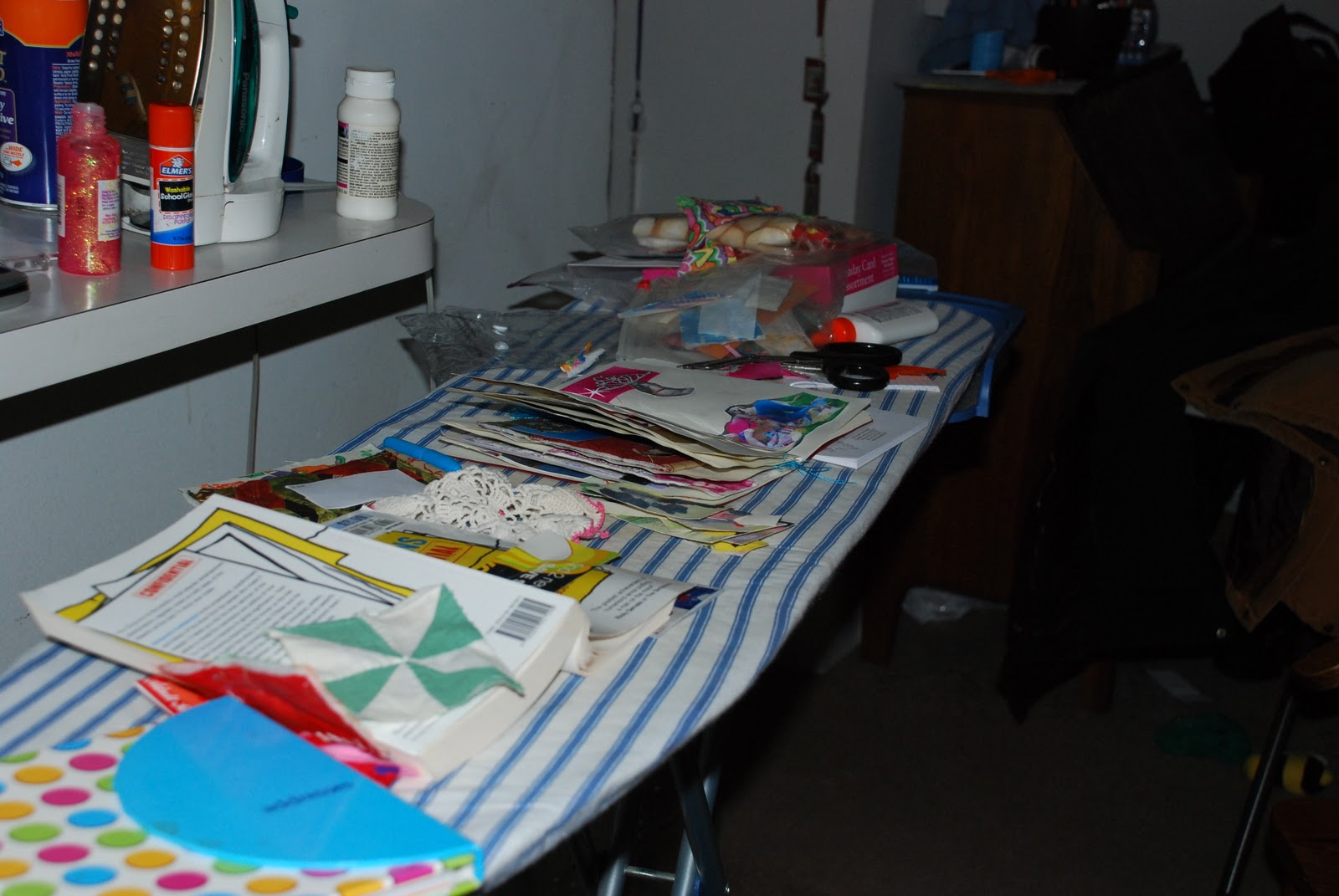
1.  Spread materials on kitchen counter and ironing board.  Open sketchbook to the middle and do the double spread first.  Be so excited at beginning that you can't hold the camera still.

2.  Drag out more materials and read that book about The Simpsons off and on while working to keep your mind engaged and disengaged simultaneously.
3.  Spread out the all of the mail art postcards you've made but not yet sent in case you decide to include some of them in the sketchbook.

4.  Pull out some of your vintage raggedy embroidered pieces for the same reason.


5.  Have no idea what fixatives will be appropriate, so strew several different kinds among the elements already brought forth.
6.  Pile half of what's collected on the ironing board and counter so they're near the sketchbook.


 7.  Glue and stitch things into the sketchbook.  Take a photo when you're about half done.  Also take a break now and then.

8.  Check in with the supervisor from time to time to ensure he approves.

January 23, 2011

Fibonacci Poetry365.21 At the Literary Event

At the Literary Event

1    I
1    told
2    the audience
3    at Day's Espresso
5    last night, for our monthly
8    reading series, that I've chosen the Fibonacci Sequence
13  as the structure for the daily poem I'm writing this year.
21  They look nice on the page, I said, but I don't know how they'll come across out loud.  How to differentiate
34  commas, hyphens, periods, and line breaks in this nonpoetic system?  Then off we went to the Great Pacific Garbage Dump and through the labor and delivery room on our way to Haiti, nodding to

55 Dr. King along the way. They laughed when I said "Waldo Ann." They fell in love with Devin at age six, back before he'd ever had that kind of dream, and they applauded (I think this is true) when I finished reading that poem. I told them I nearly didn't write it, afraid I couldn't

89  do justice to Dr. King and the stony road behind and ahead of us. And together we loathed the wicked Baby Doc Duvalier.  The poems were strong to read and good to hear.
       Afterwards, one humor writer said I'd inspired him when I spoke of posting a poem a day; that my statement changed his life.  Another poet admired my strong final lines; and I said, "Oh, Lord, they're misery.  I revise and revise and revise and count and count and count, because you can ruin a whole poem

144 if the final line is weak," which I knew she knew because I'd heard her gorgeous poetry. Another writer explained to me that the Fibonacci Sequence is simply a subset of fractals, which, in mathematics, are numbers that add back into themselves. Oh, and the writer who signed a contract with St. Martin's handed me a sheet of paper.
        "In my training," she said, "we were taught to write down the phrases that captured us, and I did that for you."  Glancing down the list, I saw she'd caught the bits that caught my attention when I wrote them:  the world itself broken; my girls so quickly women; the little death of graft; and more.
         Not until I got home did I notice that I'd left the final sentence of the Duvalier poem sitting in the printer tray.  Nobody but me was counting words.
                                                                by Mary Cartledgehayes

January 21, 2011

My sketchbook made it to New York!

I picked up this photo from the arthouse coop tumblr page -- where I discovered my own sketchbook!  It's in the middle stack, third up from the bottom; the one with the moss green silk threads hanging from it.  I'm very pleased to see it with all of its friends.  Art House Coop does public projects all year round.  Right now, they're mailing out cameras for people to take photos of whatever they choose and send back; photos will be posted online.